

After a difficult first quarter, equity markets roared back in the second quarter of 2026. Investors soured on stock markets in late February, when the outbreak of war involving the United States, Israel, and Iran sent a wave of fear through the markets and triggered a downturn that carried into March.
As is often the case, the pessimism that rose from bad news quickly subsided. Over the three months that followed, the S&P 500 gained 15%, thetechnology-heavy NASDAQ Composite surged 21%, and the Dow Jones Industrial Average (DJIA) climbed 13%. The rebound was one of the strongest quarters in recent memory, recalling a similar rebound after the pandemic in 2020.
The quarter was not without turbulence, however. The Iran conflict pushed oil prices sharply higher after the U.S. and Israel struck Iran in February, while gold — often viewed as a safe haven during inflation and times of conflict — has fallen roughly 20% since the beginning of the year. Volatility remained constant throughout the quarter: the S&P 500 dropped 2.63% on June 5th, one of its sharpest single-day declines of the period. Against this backdrop, the Federal Reserve, now led by new Chairman Kevin Warsh, held the federal-funds target rate steady at 3.5% to 3.75% at his first meeting, and expectations for an interest rate cut later in 2026 have been dwindling. In short, plenty of reasons for concern remained even as stock values climbed.
Despite the turmoil of the first quarter, results through June 30, 2026 tell a very encouraging story. The S&P 500 is up 10.2%, the DJIA has gained 9.8%, and the NASDAQ has advanced 13.1%. International markets have done even better: the MSCI Emerging Markets Index has risen an impressive 23.85% year broad global market participation like this is a reminder that opportunity is rarely confined to a single index or a single country — and that a diversified portfolio captures opportunities wherever they appear. Please see Figure 1 below for evidence supporting the importance of portfolio diversification.
The most important lesson of the quarter, however, is not about any single number. It is about investor behavior. Investors who reacted to February’s negative headlines by selling their stocks would have locked in losses and watched from the sidelines as the market staged one of its strongest quarters in years. For many investors, the hardest part of investing is rarely choosing what to buy; it is having the discipline to hold on when the news is frightening, and the temptation to sell is strongest.
This is precisely why a disciplined investment strategy must be a foundational part of your financial plan; rather than a sound plan sets your portfolio allocation in advance, based on your goals, time horizon, and tolerance for risk — not on the latest headline. It uses diversification to soften the blow of any one shock, and periodic rebalancing to buy low and sell high, reinvented in the heat of every crisis.
When the strategy is created with a disciplined approach to building and maintaining wealth, market storms become events to weather rather than emergencies demanding action.
Our role is to help you build that plan and, just as importantly, to help you stay committed to it when it matters most. If recent volatility has you second-guessing your strategy, that is exactly the conversation we welcome — before the next storm, not during it.
Figure 1: Five-Year Annualized Equity Market 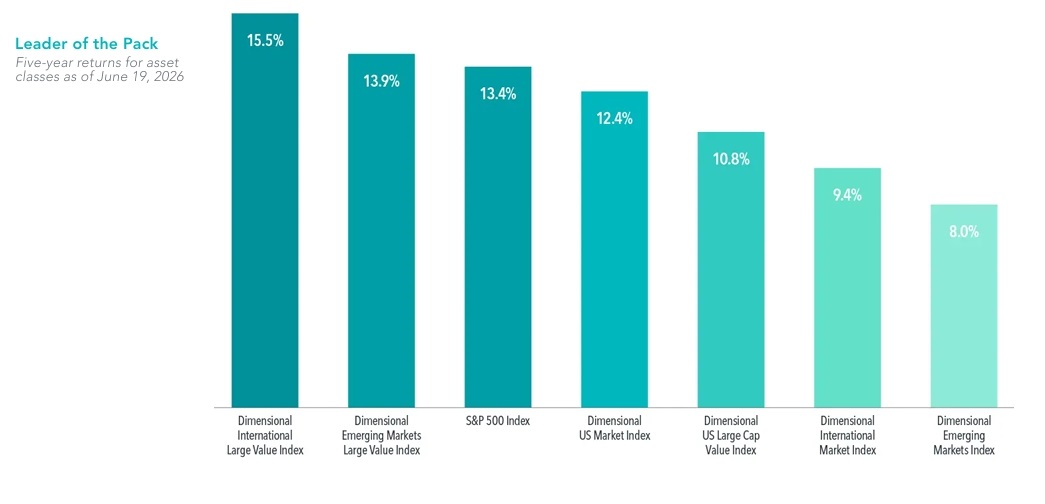 Returns
Sources: The Wall Street Journal, Dimensional Fund Advisors, S&P Dow Jones Indices LL