
US equity markets took investors on a wild roller coaster ride in the first half of 2025 amid notable swings and upheavals precipitated by global trade tariffs and geopolitical tensions. But by the end of the second quarter, investors were rewarded for their patience and discipline with stock market indices ending at or near record highs.
April Market Turbulence
After reaching an all-time high in February market volatility ensued shortly thereafter. The S&P 500 index fell by a combined 10.5% on April 3rd and 4th because of new tariff announcements on international trade partners by President Trump. The 10.5% drop was the biggest two-day loss for the index since the onset of the COVID-19 pandemic in March of 2020.
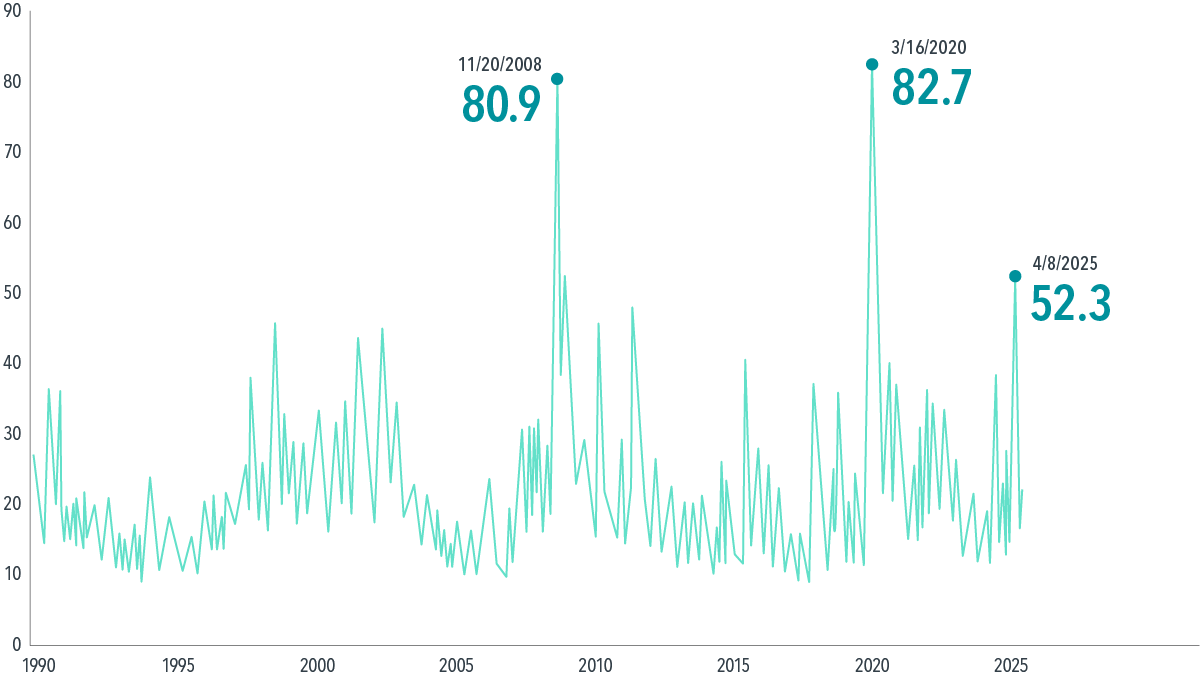
Market volatility continued throughout the month of April. The S&P 500 index moved at least 2 full percentage points either positively or negatively on eight separate days in April, with 33% of market trading days experiencing market movements of 1 percent or more. The VIX index, a common measure of US stock market volatility, spiked to levels not seen since the early days of the global pandemic (3/16/2020) and the global financial crisis (11/20/2008).
Please see Exhibit 1.
Domestic equity markets began their rebound from April’s losses in May and momentum in June carried the S&P 500 Index to a 10.94% return in the second quarter of 2025. Small stocks, represented by the Russell 2000 index, experienced a similar rebound, gaining 8.50% in the second quarter.
International Market Outperformance
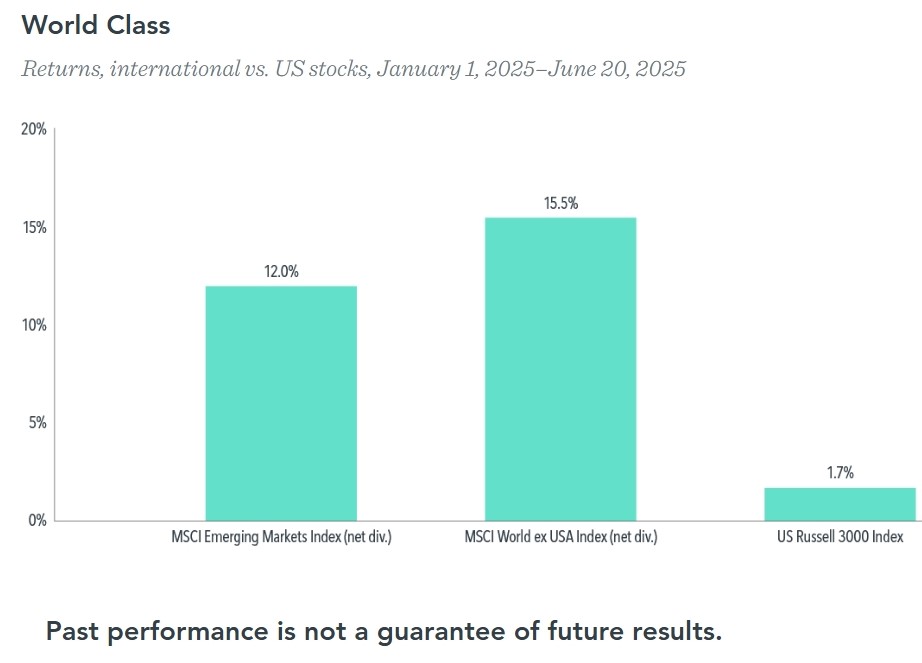
The narrative from the onset of 2025 has been the strong outperformance of international stocks over US equities. Developed and emerging international markets began 2025 strong, and continued their dominance in the second quarter, despite US stocks closing the gap significantly. The MSCI World ex US index gained 12.05% in the second quarter. Through the halfway point of 2025 the S&P 500 index posted a positive 6.20% return, the Russell 2000 index posted a negative 1.79% return, and the MSCI World ex US index posted an eye-popping 18.99% return.
Please see Exhibit 2.
Investing Lessons Revisited
The first half of 2025 reinforces several important lessons that savvy investors have learned, but let’s focus on two: the importance of diversification and understanding market volatility. Diversification is important for investment portfolios on two levels: diversifying investments within an asset class and diversification among asset classes. Everyone understands the old adage warning against placing all your eggs in one basket (diversifying within an asset class), but investors sometimes forget the importance of diversifying among asset classes. Investors concentrated in domestic equity markets missed out on some tremendous gains available in developed and emerging international markets this year. As Nobel laureate Merton Miller famously said, “Diversification is your buddy.”
Market volatility can be unnerving for many investors to experience, but it is evidence that capital markets are healthy and efficient. Market prices continually adapt to new information, so it should not surprise us that markets sometimes react to impactful events in a volatile manner. Expected returns from equity markets are always positive (otherwise nobody would invest in equities), so downward price movements in market prices are just a normal function of markets adjusting pricing so that the outlook for future market returns is positive.
Remaining committed to a long-term disciplined investment strategy, diversified appropriately and built to withstand periods of market volatility, can help investors stay the course during challenging market conditions and set them up for the long-term rewards that investing in capital markets offer.
Source: Dimensional Fund Advisors