

Recent tariff announcements and activities have sent shockwaves through global investment markets, unnerving many investors and prompting sharp selloffs in equity markets around the world. Volatility, as measured by the VIX index, has spiked to levels not seen since the Coronavirus
Pandemic five years ago.1 But when conditions change and economic uncertainty emerges, volatility is a sure sign that investment markets are behaving as they should: reacting to new information as it becomes known.
Sudden drops in the market and heightened volatility can be unnerving for investors, as can rapidly changing economic policies. The market’s job is to
continually process uncertainty in real time.
When trade and/or economic policies change swiftly, markets are incorporating a vast amount of new information and expectations about how these shifts may shape the global economy. Markets do this on a forward-looking basis, continuously incorporating new information and setting new market prices so that expected returns on investment are positive.
Economic policies have financial impacts across the economy beyond market returns. The economic implications that markets price into securities almost instantaneously play out over a longer period in the real economy. This difference in speed is important to underscore, because it points to a
difference in how we experience potentially negative (or positive) economic developments as investors versus as participants in the real economy. Even if you are worried about ongoing economic challenges, you shouldn’t necessarily expect a negative investment experience going forward, because markets have already factored in all known information into current market pricing.
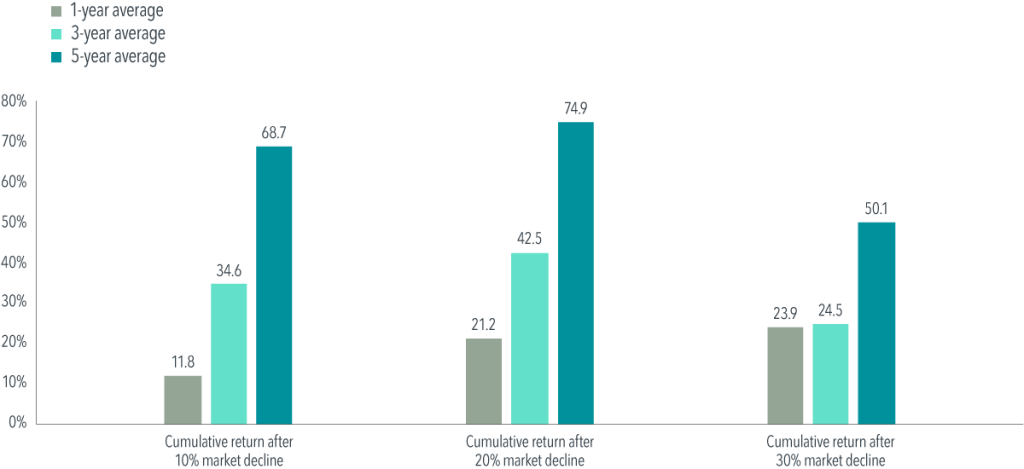
Pain you may feel now reflects markets setting prices such that expected returns are always positive. Exhibit 1 below illustrates that market returns following downturns generally have been positive. When we examine US equity returns following downturns of 10%, 20%, or even 30%, we see one-, three-, and five-year cumulative returns that are positive on average. Viewed in annualized terms across five years, returns after a 20%
decline have been close to the US market’s historical average of approximately 10%.2
When your investment portfolio experiences a sudden drop, generally the most important thing an investor can do is to stay disciplined in the
investment strategy devised to help you achieve your financial goals, while waiting for markets to process information into the price of markets on an ongoing basis.
exhibit 1
Market Gains Can Add Up After Big Declines
Fama/French Total US Market Research Index cumulative returns, July 1, 1926–December 31, 2024
Footnotes
1. Source: CBOE
2. The average annualized return for the Fama/French Total US Market Research Index for the period July 1, 1926–December 31, 2024, was 10.23%. The average annualized returns for the five-year period after 10% declines were 9.59%; after 20% declines, 10.15%; and after 30% declines, 7.18%.
Sources: Dimensional Fund Advisors, The Wall Street Journal